
If you’ve spent any time on social media lately, you’ve probably seen some version of the same joke:
“I wish I weren’t attracted to men.”
“Unfortunately, I’m straight.”
“Being attracted to men is my biggest character flaw.”
The comments are often full of people laughing in agreement. The humor is relatable because it taps into something many heterosexual women have experienced: disappointment, frustration, exhaustion, or even resentment toward heterosexual dating and relationships.
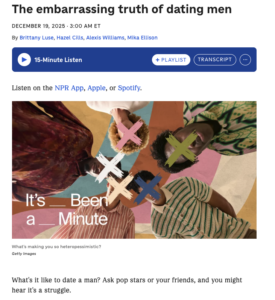
While these jokes may seem like harmless internet humor, they point to a larger cultural phenomenon that scholars have begun calling heteropessimism.
What is Heteropessimism?
The term heteropessimism was coined by cultural theorist Asa Seresin in a 2019 essay published in The New Inquiry. Seresin described it as a cultural attitude in which heterosexual relationships (particularly between men and women) are widely understood to be disappointing, unequal, emotionally draining, or fundamentally broken, yet are still treated as inevitable.
Rather than celebrating heterosexual romance as the ultimate life goal, heteropessimism is characterized by resignation. People openly complain about dating men, joke about miserable marriages, or assume that emotional dissatisfaction is simply part of being straight.
Importantly, heteropessimism is NOT simply disliking dating or having bad relationship experiences. Nor is it the same as choosing to remain single. Instead, it reflects a broader cultural belief that heterosexual relationships are inherently flawed, and that there’s little anyone can do about it.
In other words, the expectation isn’t necessarily that heterosexual relationships should be fulfilling. It’s that they probably won’t be.
Why has Heteropessimism Become More Visible?
Although dissatisfaction with heterosexual relationships is hardly new, several cultural shifts have made heteropessimism much more visible over the past decade.
Women are no longer willing to simply accept inequality.
For much of history, women had fewer legal rights, less financial independence, and greater social pressure to marry regardless of relationship quality. Many inequities within heterosexual relationships were normalized because women often had limited alternatives.
Today, women have greater access to education, careers, financial independence, and communities outside of marriage than previous generations. With those changes has come higher expectations.
Many women are no longer looking simply for a provider or someone to start a family with. They want emotional intimacy, mutual respect, equitable division of household labor, intellectual compatibility, and shared responsibility for the invisible work that keeps relationships functioning.
Unfortunately, research consistently shows that heterosexual women still perform a disproportionate amount of domestic labor, emotional labor, and caregiving – even when both partners work full-time, AND even in marriages where she is a higher earner than her husband.
This creates a growing mismatch between what women now expect from relationships and what many experience in practice.
As feminist scholar bell hooks famously wrote, patriarchy harms everyone—but it often teaches men to avoid vulnerability while teaching women to become emotional caretakers. Those dynamics can make intimacy difficult even when both partners genuinely care for one another.
Social media has made private frustrations public.

Before the internet, relationship dissatisfaction often stayed within the home or close circles of friends.
Today, millions of people publicly share stories about emotional labor, weaponized incompetence, “man flu,” invisible household work, dating app burnout, and relationship experiences ranging from disappointing to dangerous and abusive. Entire online communities have emerged around these shared frustrations.
While social media certainly amplifies negativity, it has also helped many women realize that their experiences are not isolated.
For some, that realization is validating.
For others, it contributes to a sense that all heterosexual relationships are doomed to repeat the same patterns.
Gender politics have become increasingly polarized.
Many people feel that conversations about gender have become more contentious than they were even a decade ago.
The rise of online misogyny, influencer culture promoting rigid gender roles, backlash against feminism, and growing political debates over reproductive and voting rights have all shaped how many people approach dating.
In the United States, the rollback of federal abortion protections following the Supreme Court’s 2022 decision in Dobbs v. Jackson Women’s Health Organization also changed the landscape of heterosexual relationships in tangible ways. Pregnancy has always carried unequal physical risks, but many women now navigate dating with increased awareness of the legal, medical, and economic consequences that can accompany those risks.
Movement towards gender equality inevitably changes relationships because equality requires giving up unearned advantages. Expectations that women take on most of the emotional labor, domestic work, or caregiving responsibilities are increasingly being challenged, and not everyone welcomes those changes. While some men have embraced more equitable partnerships, others have interpreted women’s higher standards as an attack on masculinity rather than a call for reciprocity. In an online environment where outrage spreads faster than nuance, these tensions are often magnified, contributing to a dating culture marked by mistrust and defensiveness.
It’s easy to assume that happiness has to be something big or extraordinary. However, our brains are wired to adapt quickly to major positive events. This is a phenomenon psychologists often refer to as hedonic adaptation. Large accomplishments eventually become our new normal.
Small, intentional moments of joy, on the other hand, can be experienced again and again without needing dramatic life changes. Over time, these moments can help create a greater sense of balance, appreciation, and emotional resilience.
A Feminist Perspective: The Problem Isn’t Necessarily Men—It’s Patriarchy
One common misunderstanding is that feminism is anti-men.
It isn’t.
Feminism critiques systems, not individual people.
From a feminist perspective, heteropessimism isn’t evidence that men are inherently incapable of healthy relationships. Rather, it reflects the ongoing effects of patriarchal socialization.
Patriarchy teaches men and women different rules for relationships from childhood. Women are often encouraged to become emotionally attuned, relationally responsible, and accommodating. Men are often rewarded for emotional stoicism, independence, and self-sufficiency. Neither set of expectations prepares people particularly well for relationships built on mutual vulnerability and shared responsibility.
Many heterosexual couples therefore find themselves caught in unequal patterns that neither partner consciously chose. Women become exhausted from carrying the emotional, domestic, and mental load. Men feel criticized or inadequate without having been taught the relational skills being asked of them.
Everyone loses.
Rather than asking why women seem increasingly pessimistic about heterosexual relationships, feminism asks a different question:
Why are so many relationships still organized around unequal expectations despite decades of progress?
Does Heteropessimism Become a Self-fulfilling Prophecy?
It can.

If someone enters every relationship expecting disappointment, they may become hypervigilant for evidence that confirms those beliefs. Cynicism can make vulnerability feel unsafe and genuine intimacy harder to build.
At the same time, optimism alone cannot fix structural inequality.
Healthy relationships require more than positive thinking. They require accountability, communication, emotional maturity, equitable partnership, and a willingness to question inherited gender roles.
The answer, then, is not simply to “have higher standards” or “lower your expectations.” It’s to recognize that both personal growth and cultural change matter.
These moments of joy won’t eliminate difficult emotions, but they can help remind us that difficult moments are rarely the whole story.
Seek An Individual Therapist at Yellow Chair Collective in Los Angeles or New York
If you are seeking therapy specifically tailored to your needs, consider reaching out to the therapists at Yellow Chair Collective. We understand that there may be unique contextual factors that may influence your experiences.
At our Los Angeles, CA, and New York City, NY-based therapy practice, we have many skilled, trauma-informed, and culturally sensitive therapists who can provide an empowering therapeutic experience. For your added convenience and simplicity, we offer online therapy for anyone in the state of California or New York. We know that navigating your mental health journey can be challenging, and we want to support you along the way. Follow the steps below to begin.
- Fill out the contact form to get connected with us.
- Get matched with one of our culturally sensitive therapists.
- Start the next step in your healing journey today.
Other Services at Yellow Chair Collective
There are many options for treatment using online therapy in California and New York, it just depends on what you’re needing. And while we certainly service Asian American folks, we also work with individuals from other cultures, too. So, whether you’re needing support in overcoming anxiety, burnout, trauma, or PTSD, we can help. Likewise, we serve teens and couples in need of support, too. So when you start online therapy with us, you can bring your whole self, including past struggles, cultural impacts, and more.